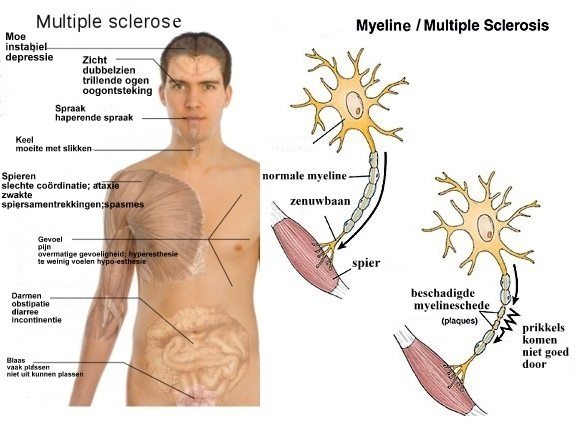
Ontsteking van de oogzenuw een van de eerste klachten bij Multiple Sclerose (MS)
Door Multiple Sclerose (MS) kan de oogzenuw ontsteken, waardoor u klachten krijgt bij het zien. De aandoening heet neuritis retrobulbaris of neuritis optica. Vaak begint Multiple Sclerose (MS) met deze klacht, maar ze kan ook later in het verloop optreden. In sommige gevallen komt de klacht later weer terug. De klacht kan ernstig zijn (helemaal niets meer zien met dat oog) of minder ernstig. Dit is afhankelijk van hoe zwaar de oogzenuw getroffen is.

Vriendelijke groet,
Willy Witsel


Orthomoleculaire geneeskunde wat is dat?
Het behandelingsprotocol voor Multiple Sclerose (MS) is ontwikkeld op basis van principes uit de orthomoleculaire geneeskunde. Orthomoleculaire geneeskunde wat is dat nu weer? Dat is eenvoudig uitgelegd. “Ortho” betekent “goede” en “moleculair” is een ander woord voor “molecuul”. Dus orthomoleculaire geneeskunde betekent geneeskunde met goede moleculen, dus: genezing m.b.v. vitamines, mineralen, aminozuren, enzymen en spoorelementen. Orthomoleculaire geneeskunde is een geneeskunde waarbij geprobeerd wordt het lichaam te ondersteunen zich zelf te genezen. Dat lukt niet altijd, maar vaak wel en ook voor de orthomoleculaire geneeskunde geldt: voorkomen is beter dan genezen.Orthomoleculair informatiecentrum Multiple Sclerose (MS)
- Treatment Multiple Sclerosis (MS) - Automatische Nederlandse vertaling
- Wetenschappelijke informatie over voedingssupplementen
Wetenschappelijk onderzoek Multiple Sclerose
Het komende jaar wordt er gewerkt aan een wetenschappelijk onderzoek op het gebied van de behandeling van Multiple Sclerose. Iedereen kan hier aan meewerken. MS patienten die meedoen kunnen contact met elkaar hebben via de MS HELP desk. De resultaten van dit onderzoek komen op deze pagina beschikbaar.Vitamine D
- A longitudinal study of serum 25-hydroxyvitamin D and intact parathyroid hormone levels indicate the importance of vitamin D and calcium homeostasis regulation in multiple sclerosis
BACKGROUND: Past sun exposure and vitamin D3 supplementation have been associated with a reduced risk of multiple sclerosis (MS). There are no previous longitudinal studies of vitamin D in MS. OBJECTIVES: To compare regulation of vitamin D and calcium homeostasis between patients with MS and healthy controls. To study the correlation of parameters of vitamin D metabolism with MS activity. METHODS: We measured 25-hydroxyvitamin D (25(OH)D), parathyroid hormone (PTH), calcium, phosphate, magnesium, chloride, alkaline phosphatase, albumin and thyroid stimulating hormone in serum every 3 months and at the time of relapse over 1 year in 23 patients with MS and in 23 healthy controls. MRI burden of disease and T2 activity were assessed every 6 months. RESULTS: Vitamin D deficiency (S-25(OH)D < or = 37 nmol/l) was common, affecting half of the patients and controls at some time in the year. Seasonal variation of 25(OH)D was similar in patients and controls, but 25(OH)D serum levels were lower and intact PTH (iPTH) serum levels were higher during MS relapses than in remission. All 21 relapses during the study occurred at serum iPTH levels > 20 ng/l (2.2 pmol/l), whereas 38% of patients in remission had iPTH levels < or = 20 ng/l. Patients with MS had a relative hypocalcaemia and a blunted PTH response in the winter. There was no correlation between serum 25(OH)D and MRI parameters. CONCLUSIONS: The endocrine circuitry regulating serum calcium may be altered in MS. There is an inverse relationship between serum vitamin D level and MS clinical activity. The role of vitamin D in MS must be explored further. - Therapeutic potential of vitamin D for multiple sclerosis
Multiple sclerosis (MS) is a major inflammatory and demyelinating disease of the central nervous system and has an increasing prevalence in populations residing at higher latitudes. This observation may indicate a protective effect of sunlight exposure, which is reduced at higher latitudes and may contribute to insufficient levels of vitamin D in the MS population. The vitamin D hormone is important for bone metabolism and can regulate cell proliferation and differentiation as well as apoptosis and immune regulation in immune cells such as T helper cells and dendritic cells. Evidence from experimental autoimmune encephalomyelitis and prospective studies on MS suggests an important role of vitamin D as a modifiable environmental factor in MS. These provide guidance for future studies with regard to the potential role of vitamin D in the prevention and/or treatment of MS. Here, we first review the metabolism and immune functions of vitamin D. Then, we describe the current thinking on the etiology of vitamin D in MS and the accumulating evidence pointing to a link between vitamin D and MS. Further, we describe how genetic susceptibility interacts with environmental risk factors at the population level, MS-associated risk factors, and genetic studies related to the vitamin D receptor. This review also discusses the therapeutic potential of vitamin D for treating MS - Vitamin D: a natural inhibitor of multiple sclerosis
Inheriting genetic risk factors for multiple sclerosis (MS) is not sufficient to cause this demyelinating disease of the central nervous system; exposure to environmental risk factors is also required. MS may be preventable if these unidentified environmental factors can be avoided. MS prevalence increases with decreasing solar radiation, suggesting that sunlight may be protective in MS. Since the vitamin D endocrine system is exquisitely responsive to sunlight, and MS prevalence is highest where environmental supplies of vitamin D are lowest, we have proposed that the hormone, 1, 25-dihydroxycholecalciferol (1,25-(OH)2D3), may protect genetically-susceptible individuals from developing MS. Evidence consistent with this hypothesis comes not only from geographic studies, but also genetic and biological studies. Over-representation of the vitamin D receptor gene b allele was found in Japanese MS patients, suggesting it may confer MS susceptibility. Fish oil is an excellent vitamin D source, and diets rich in fish may lower MS prevalence or severity. Vitamin D deficiency afflicts most MS patients, as demonstrated by their low bone mass and high fracture rates. However, the clearest evidence that vitamin D may be a natural inhibitor of MS comes from experiments with experimental autoimmune encephalomyelitis (EAE), a model of MS. Treatment of mice with 1,25-(OH)2D3 completely inhibited EAE induction and progression. The hormone stimulated the synthesis of two anti-encephalitogenic cytokines, interleukin 4 and transforming growth factor beta-1, and influenced inflammatory cell trafficking or apoptosis. If vitamin D is a natural inhibitor of MS, providing supplemental vitamin D to individuals who are at risk for MS would be advisable. - Vitamin D and multiple sclerosis
Recently, it has been clearly demonstrated that exogenous 1,25-dihydroxyvitamin D3, the hormonal form of vitamin D3, can completely prevent experimental autoimmune encephalomyelitis (EAE), a widely accepted mouse model of human multiple sclerosis (MS). This finding has focused attention on the possible relationship of this disease to vitamin D. Although genetic traits certainly contribute to MS susceptibility, an environmental factor is also clearly involved. It is our hypothesis that one crucial environmental factor is the degree of sunlight exposure catalyzing the production of vitamin D3 in skin, and, further, that the hormonal form of vitamin D3 is a selective immune system regulator inhibiting this autoimmune disease. Thus, under low-sunlight conditions, insufficient vitamin D3 is produced, limiting production of 1,25-dihydroxyvitamin D3, providing a risk for MS. Although the evidence that vitamin D3 is a protective environmental factor against MS is circumstantial, it is compelling. This theory can explain the striking geographic distribution of MS, which is nearly zero in equatorial regions and increases dramatically with latitude in both hemispheres. It can also explain two peculiar geographic anomalies, one in Switzerland with high MS rates at low altitudes and low MS rates at high altitudes, and one in Norway with a high MS prevalence inland and a lower MS prevalence along the coast. Ultraviolet (UV) light intensity is higher at high altitudes, resulting in a greater vitamin D3 synthetic rate, thereby accounting for low MS rates at higher altitudes. On the Norwegian coast, fish is consumed at high rates and fish oils are rich in vitamin D3. Further, experimental work on EAE provides strong support for the importance of vitamin D3 in reducing the risk and susceptibility for MS. If this hypothesis is correct, then 1,25-dihydroxyvitamin D3 or its analogs may have great therapeutic potential in patients with MS. More importantly, current research together with data from migration studies opens the possibility that MS may be preventable in genetically susceptible individuals with early intervention strategies that provide adequate levels of hormonally active 1,25-dihydroxyvitamin D3 or its analogs. - Vitamin D as an immune modulator in multiple sclerosis, a review
The role of vitamin D in calcium homeostasis is well known. More recently vitamin D has become a topic of interest in immune regulation and multiple sclerosis. The main reason for this is the observed geographical distribution of multiple sclerosis. Areas with high sunlight exposure, the principal inducer of vitamin D synthesis, have a relatively low prevalence of multiple sclerosis and vice versa. Furthermore, low levels of the principal vitamin D metabolite (25-hydroxy vitamin D) in the circulation are associated with a high incidence of multiple sclerosis. Other epidemiological evidence also supports the view that vitamin D metabolites have an immune and disease modulating effect in multiple sclerosis. Experimental research in vitro and in animal models has further clarified the interaction of vitamin D metabolites with the immune system. The evidence obtained from these studies strongly supports a model in which vitamin D mediates a shift to a more anti-inflammatory immune response, and in particular to enhanced regulatory T cell functionality. In the current review we link the basic knowledge on vitamin D and immune regulation with the vitamin D related observations in multiple sclerosis. We conclude that there is a sound basis on which to initiate double-blind placebo-controlled trials that not only address the effect of vitamin D on the clinical outcome of multiple sclerosis, but also on the regulatory T cell compartment. - Multiple sclerosis and vitamin D: an update
MS is a chronic, immune-mediated inflammatory and neurodegenerative disease of the central nervous system (CNS), with an etiology that is not yet fully understood. The prevalence of MS is highest where environmental supplies of vitamin D are lowest. It is well recognized that the active hormonal form of vitamin D, 1,25-dihydroxyvitamin D (1,25-(OH)(2)D), is a natural immunoregulator with anti-inflammatory action. The mechanism by which vitamin D nutrition is thought to influence MS involves paracrine or autocrine metabolism of 25OHD by cells expressing the enzyme 1 alpha-OHase in peripheral tissues involved in immune and neural function. Administration of the active metabolite 1,25-(OH)(2)D in mice and rats with experimental allergic encephalomyelitis (EAE, an animal model of MS) not only prevented, but also reduced disease activity. 1,25-(OH)(2)D alters dendritic cell and T-cell function and regulates macrophages in EAE. Interestingly, 1,25-(OH)(2)D is thought to be operating on CNS constituent cells as well. Vitamin D deficiency is caused by insufficient sunlight exposure or low dietary vitamin D(3) intake. Subtle defects in vitamin D metabolism, including genetic polymorphisms related to vitamin D, might possibly be involved as well. Optimal 25OHD serum concentrations, throughout the year, may be beneficial for patients with MS, both to obtain immune-mediated suppression of disease activity, and also to decrease disease-related complications, including increased bone resorption, fractures, and muscle weakness. - Vitamin D toxicity, policy, and science
The serum 25-hydroxyvitamin D [25(OH)D] concentration that is the threshold for vitamin D toxicity has not been established. Hypercalcemia is the hazard criterion for vitamin D. Past policy of the Institute of Medicine has set the tolerable upper intake level (UL) for vitamin D at 50 mug (2000 IU)/d, defining this as "the highest level of daily nutrient intake that is likely to pose no risks of adverse health effects to almost all individuals in the general population." However, because sunshine can provide an adult with vitamin D in an amount equivalent to daily oral consumption of 250 mug (10,000 IU)/d, this is intuitively a safe dose. The incremental consumption of 1 mug (40 IU)/day of vitamin D(3) raises serum 25(OH)D by approximately 1 nM (0.4 ng/ml). Therefore, if sun-deprived adults are to maintain serum 25(OH)D concentrations >75 nM (30 ng/ml), they will require an intake of more than the UL for vitamin D. The mechanisms that limit vitamin D safety are the capacity of circulating vitamin D-binding protein and the ability to suppress 25(OH)D-1-alpha-hydroxylase. Vitamin D causes hypercalcemia when the "free" concentration of 1,25-dihydroxyvitamin D is inappropriately high. This displacement of 1,25(OH)(2)D becomes excessive as plasma 25(OH)D concentrations become higher than at least 600 nM (240 ng/ml). Plasma concentrations of unmetabolized vitamin D during the first days after an acute, large dose of vitamin D can reach the micromolar range and cause acute symptoms. The clinical trial evidence shows that a prolonged intake of 250 mug (10,000 IU)/d of vitamin D(3) is likely to pose no risk of adverse effects in almost all individuals in the general population; this meets the criteria for a tolerable upper intake level. - Risk assessment for vitamin D
The objective of this review was to apply the risk assessment methodology used by the Food and Nutrition Board (FNB) to derive a revised safe Tolerable Upper Intake Level (UL) for vitamin D. New data continue to emerge regarding the health benefits of vitamin D beyond its role in bone. The intakes associated with those benefits suggest a need for levels of supplementation, food fortification, or both that are higher than current levels. A prevailing concern exists, however, regarding the potential for toxicity related to excessive vitamin D intakes. The UL established by the FNB for vitamin D (50 microg, or 2000 IU) is not based on current evidence and is viewed by many as being too restrictive, thus curtailing research, commercial development, and optimization of nutritional policy. Human clinical trial data published subsequent to the establishment of the FNB vitamin D UL published in 1997 support a significantly higher UL. We present a risk assessment based on relevant, well-designed human clinical trials of vitamin D. Collectively, the absence of toxicity in trials conducted in healthy adults that used vitamin D dose > or = 250 microg/d (10,000 IU vitamin D3) supports the confident selection of this value as the UL. - Safety of vitamin D3 in adults with multiple sclerosis
BACKGROUND: Vitamin D3 may have therapeutic potential in several diseases, including multiple sclerosis. High doses of vitamin D(3) may be required for therapeutic efficacy, and yet tolerability--in the present context, defined as the serum concentration of 25-hydroxyvitamin D [25(OH)D] that does not cause hypercalcemia--remains poorly characterized. OBJECTIVE: The objective of the study was to characterize the calcemic response to specific serum 25(OH)D concentrations. DESIGN: In a 28-wk protocol, 12 patients in an active phase of multiple sclerosis were given 1200 mg elemental Ca/d along with progressively increasing doses of vitamin D3: from 700 to 7000 microg/wk (from 28 000 to 280 000 IU/wk). RESULTS: Mean (+/- SD) serum concentrations of 25(OH)D initially were 78 +/- 35 nmol/L and rose to 386 +/- 157 nmol/L (P < 0.001). Serum calcium concentrations and the urinary ratio of calcium to creatinine neither increased in mean values nor exceeded reference values for any participant (2.1-2.6 mmol/L and <1.0, respectively). Liver enzymes, serum creatinine, electrolytes, serum protein, and parathyroid hormone did not change according to Bonferroni repeated-measures statistics, although parathyroid hormone did decline significantly according to the paired t test. Disease progression and activity were not affected, but the number of gadolinium-enhancing lesions per patient (assessed with a nuclear magnetic brain scan) decreased from the initial mean of 1.75 to the end-of-study mean of 0.83 (P = 0.03). CONCLUSIONS: Patients' serum 25(OH)D concentrations reached twice the top of the physiologic range without eliciting hypercalcemia or hypercalciuria. The data support the feasibility of pharmacologic doses of vitamin D3 for clinical research, and they provide objective evidence that vitamin D intake beyond the current upper limit is safe by a large margin.
Alpha Lipoc Acid
- Lipoic acid: a novel therapeutic approach for multiple sclerosis and other chronic inflammatory diseases of the CNS
The naturally occurring antioxidant lipoic acid (LA) was first described as an essential cofactor for the conversion of pyruvate to Acetyl-CoA, a critical step in respiration. LA is now recognized as a compound that has many biological functions. Along with its reduced form dihydrolipoic acid (DHLA), LA reduces and recycles cellular antioxidants such as glutathione, and chelates zinc, copper and other transition metal ions in addition to heavy metals. LA can also act as a scavenger of reactive oxygen and nitrogen species. By acting as an insulin mimetic agent, LA stimulates glucose uptake in many different cell types and can also modulate insulin signaling. The p38 and ERK MAP kinase pathways, AKT and NFkappaB are all regulated by LA. In addition, LA activates the prostaglandin EP2 and EP4 receptors to stimulate the production of the small molecule cyclic adenosine 5' monophosphate (cAMP). These diverse actions suggest that LA may be therapeutically effective in treating oxidative stress associated diseases. This review discusses the known biochemical properties of LA, its antioxidant properties, its ability to modulate signal transduction pathways, and the recent progress made in the utilization of LA as a therapeutic alternative for multiple sclerosis, Alzheimer's disease and diabetic neuropathy. - Lipoic acid in multiple sclerosis: a pilot study
Lipoic acid (LA) is an antioxidant that suppresses and treats an animal model of multiple sclerosis (MS), experimental autoimmune encephalomyelitis. The purpose of this study was to determine the pharmacokinetics (PK), tolerability and effects on matrix metalloproteinase-9 (MMP-9) and soluble intercellular adhesion molecule-1 (sICAMP-1) of oral LA in patients with MS. Thirty-seven MS subjects were randomly assigned to one of four groups: placebo, LA 600 mg twice a day, LA 1200 mg once a day and LA 1200 mg twice a day. Subjects took study capsules for 14 days. We found that subjects taking 1200 mg LA had substantially higher peak serum LA levels than those taking 600 mg and that peak levels varied considerably among subjects. We also found a significant negative correlation between peak serum LA levels and mean changes in serum MMP-9 levels (T = -0.263, P =0.04). There was a significant dose response relationship between LA and mean change in serum sICAM-1 levels (P =0.03). We conclude that oral LA is generally well tolerated and appears capable of reducing serum MMP-9 and sICAM-1 levels. LA may prove useful in treating MS by inhibiting MMP-9 activity and interfering with T-cell migration into the CNS. - Alpha lipoic acid inhibits human T-cell migration: implications for multiple sclerosis
We have demonstrated previously the ability of the antioxidant alpha lipoic acid (ALA) to suppress and treat a model of multiple sclerosis (MS), relapsing experimental autoimmune encephalomyelitis (EAE). We describe the effects of ALA and its reduced form, dihydrolipoic acid (DHLA), on the transmigration of human Jurkat T cells across a fibronectin barrier in a transwell system. ALA and DHLA inhibited migration of Jurkat cells in a dose-dependent fashion by 16-75%. ALA and DHLA reduced matrix metalloproteinase-9 (MMP-9) activity by 18-90% in Jurkat cell supernatants. GM6001, a synthetic inhibitor of MMP, reduced Jurkat cell migration, but not as effectively as ALA and DHLA did. Both ALA and DHLA downmodulated the surface expression of the alpha4beta1 integrin (very late activation-4 antigen; VLA-4), which binds fibronectin and its endothelial cell ligand vascular cell adhesion molecule-1 (VCAM-1). Moreover, ALA, but not DHLA, reduced MMP-9-specific mRNA and extracellular MMP-9 from Jurkat cells and their culture supernatants as detected by relative reverse transcriptase-polymerase chain reaction (RT-PCR) and enzyme-linked immunosorbent assay (ELISA), respectively. ALA and DHLA inhibited Jurkat cell migration and have different mechanisms for inhibiting MMP-9 activity. These data, coupled with its ability to treat relapsing EAE, suggest that ALA warrants investigation as a therapy for MS.
Vitamin B12
- Vitamin B12, folic acid, and the nervous system
There are many reasons for reviewing the neurology of vitamin-B12 and folic-acid deficiencies together, including the intimate relation between the metabolism of the two vitamins, their morphologically indistinguishable megaloblastic anaemias, and their overlapping neuropsychiatric syndromes and neuropathology, including their related inborn errors of metabolism. Folates and vitamin B12 have fundamental roles in CNS function at all ages, especially the methionine-synthase mediated conversion of homocysteine to methionine, which is essential for nucleotide synthesis and genomic and non-genomic methylation. Folic acid and vitamin B12 may have roles in the prevention of disorders of CNS development, mood disorders, and dementias, including Alzheimer's disease and vascular dementia in elderly people. - Vitamin B12, demyelination, remyelination and repair in multiple sclerosis
Multiple Sclerosis (MS) and vitamin B12 deficiency share common inflammatory and neurodegenerative pathophysiological characteristics. Due to similarities in the clinical presentations and MRI findings, the differential diagnosis between vitamin B12 deficiency and MS may be difficult. Additionally, low or decreased levels of vitamin B12 have been demonstrated in MS patients. Moreover, recent studies suggest that vitamin B12, in addition to its known role as a co-factor in myelin formation, has important immunomodulatory and neurotrophic effects. These observations raise the questions of possible causal relationship between the two disorders, and suggest further studies of the need to close monitoring of vitamin B12 levels as well as the potential requirement for supplementation of vitamin B12 alone or in combination with the immunotherapies for MS patients. - Neurological disorders of vitamin B12 deficiency
It is almost two hundred years since the description of the first neurological disorders in vitamin B12 deficiency. In spite of that, not all the aspects of the biological effect of the vitamin have been explained. It is well known, that the vitamin performs an important function in organic metabolism and two types of biochemical reactions depend on it. The haematological, gastrological and neurological disorders are the result of deficiency of that vitamin. This article deals with the neurological disorders--subacute degeneration changes of the spinal cord, polyneuropathy and psychical disorders--which accompany vitamin B12 deficiency. It also presents aetiology, epidemiology, clinical symptoms, pathomorphology and it describes the deviations which occur in accessory investigations. The authors pay special attention to the abnormalities which can occur in neurophysiological and imaging examinations made by neurologists. They concentrate on the problems of the differences, especially between multiple sclerosis and subacute degeneration. The article presents the treatment of neurological disorders with regard to different authors' opinions. The importance of the early diagnosis and treatment till regression of pathological symptoms has been particularly stressed. - Multiple sclerosis and vitamin B12 metabolism
Multiple sclerosis (MS) is occasionally associated with vitamin B12 deficiency. Recent studies have shown an increased risk of macrocytosis, low serum and/or CSF vitamin B12 levels, raised plasma homocysteine and raised unsaturated R-binder capacity in MS. The aetiology of the vitamin B12 deficiency in MS is often uncertain and a disorder of vitamin B12 binding or transport is suspected. The nature of the association of vitamin B12 deficiency and MS is unclear but is likely to be more than coincidental. There is a remarkable similarity in the epidemiology of MS and pernicious anaemia. Vitamin B12 deficiency should always be looked for in MS. The deficiency may aggravate MS or impair recovery. There is evidence that vitamin B12 is important for myelin synthesis and integrity but further basic studies are required. - Vitamin B12 and its relationship to age of onset of multiple sclerosis
Attention has been focused recently on the association between vitamin B12 metabolism and the pathogenesis of multiple sclerosis (MS). Several recent reports have documented vitamin B12 deficiency in patients with MS. The etiology of this deficiency in MS is unknown. The majority of these patients do not have pernicious anemia and serum levels of the vitamin are unrelated to the course or chronicity of the disease. Moreover, vitamin B12 does not reverse the associated macrocytic anemia nor are the neurological deficits of MS improved following supplementation with vitamin B12. It has been suggested that vitamin B12 deficiency may render the patient more vulnerable to the putative viral and/or immunologic mechanisms widely suspected in MS. In the present communication, we report that serum vitamin B12 levels in MS patients are related to the age of onset of the disease. Specifically, we found in 45 MS patients that vitamin B12 levels were significantly lower in those who experienced the onset of first neurological symptoms prior to age 18 years (N = 10) compared to patients in whom the disease first manifested after age 18 (N = 35). In contrast, serum folate levels were unrelated to age of onset of the disease. As vitamin B12 levels were statistically unrelated to chronicity of illness, these findings suggest a specific association between the timing of onset of first neurological symptoms of MS and vitamin B12 metabolism. In addition, since vitamin B12 is required for the formation of myelin and for immune mechanisms, we propose that its deficiency in MS is of critical pathogenetic significance.
Carnitine
- Levocarnitine administration in multiple sclerosis patients with immunosuppressive therapy-induced fatigue
Nutritional factors and comedications are among the postulated causes of fatigue, a highly prevalent symptom in the multiple sclerosis (MS) population, with serious impact on patients' quality of life. Deficiency of carnitine may play a role by reducing energy production through fatty acid oxidation and numerous MS therapies can induce fatigue syndrome. The aim of this prospective open-labelled study was to collect and study serum carnitine levels in MS patients with and without disease-modifying treatment-induced fatigue syndrome. We investigated whether restoration of the carnitine pool might improve treatment-induced fatigue in MS patients. In our study, there was no statistical difference in fatigue frequency between treated and untreated patients (P=0.5). Matched to age, gender and treatments, carnitine levels were lower for MS treated patients compared to untreated MS patients (P <0.05) or controls (P <0.001). Consecutive patients with low plasma carnitine levels who experienced fatigue were substituted. Treatment consisted of oral levocarnitine, 3-6 g daily. All patients achieved normal plasma carnitine levels. For 63% of patients treated with immunosuppressive or immunomodulatory therapies, oral levocarnitine adjunction decreased fatigue intensity, especially in patients treated with cyclophosphamide and interferon beta. - Comparison of the effects of acetyl L-carnitine and amantadine for the treatment of fatigue in multiple sclerosis: results of a pilot, randomised, double-blind, crossover tr
Treatment with acetyl L-carnitine (ALCAR) has been shown to improve fatigue in patients with chronic fatigue syndrome, but there have been no trials on the effect of ALCAR for treating fatigue in multiple sclerosis (MS). To compare the efficacy of ALCAR with that of amantadine, one of the drugs most widely used to treat MS-related fatigue, 36 MS patients presenting fatigue were enrolled in a randomised, double-blind, crossover study. Patients were treated for 3 months with either amantadine (100 mg twice daily) or ALCAR (1 g twice daily). After a 3-month washout period, they crossed over to the alternative treatment for 3 months. Patients were rated at baseline and every 3 months according to the Fatigue Severity Scale (FSS), the primary endpoint of the study. Secondary outcome variables were: Fatigue Impact Scale (FIS), Beck Depression Inventory (BDI) and Social Experience Checklist (SEC). Six patients withdrew from the study because of adverse reactions (five on amantadine and one on ALCAR). Statistical analysis showed significant effects of ALCAR compared with amantadine for the Fatigue Severity Scale (p = 0.039). There were no significant effects for any of the secondary outcome variables. The results of this study show that ALCAR is better tolerated and more effective than - Disruption of thiol homeostasis and nitrosative stress in the cerebrospinal fluid of patients with active multiple sclerosis: evidence for a protective role of acetylcarnitine
Recent studies suggest that NO and its reactive derivative peroxynitrite are implicated in the pathogenesis of multiple sclerosis (MS). Patients dying with MS demonstrate increased astrocytic inducible nitric oxide synthase activity, as well as increased levels of iNOS mRNA. Peroxynitrite is a strong oxidant capable of damaging target tissues, particularly the brain, which is known to be endowed with poor antioxidant buffering capacity. Inducible nitric oxide synthase is upregulated in the central nervous system (CNS) of animals with experimental allergic encephalomyelitis (EAE) and in patients with MS. We have recently demonstrated in patients with active MS a significant increase of NOS activity associated with increased nitration of proteins in the cerebrospinal fluid (CSF). Acetylcarnitine is proposed as a therapeutic agent for several neurodegenerative disorders. Accordingly, in the present study, MS patients were treated for 6 months with acetylcarnitine and compared with untreated MS subjects or with patients noninflammatory neurological conditions, taken as controls. Western blot analysis showed in MS patients increased nitrosative stress associated with a significant decrease of reduced glutathione (GSH). Increased levels of oxidized glutathione (GSSG) and nitrosothiols were also observed. Interestingly, treatment of MS patients with acetylcarnitine resulted in decreased CSF levels of NO reactive metabolites and protein nitration, as well as increased content of GSH and GSH/GSSG ratio. Our data sustain the hypothesis that nitrosative stress is a major consequence of NO produced in MS-affected CNS and implicate a possible important role for acetylcarnitine in protecting brain against nitrosative stress, which may underlie the pathogenesis of MS. - Serum carnitine and disabling fatigue in multiple sclerosis
The serum concentrations of total, free and acylcarnitine were compared in 25 patients with multiple sclerosis (MS) and among age- and sex-matched normal controls by the new enzymatic cycling method in order to clarify whether the fatigue in MS might be due to possible carnitine-related fatty acid metabolic abnormalities in the mitochondria of skeletal muscles. Patients with MS were divided into those with and those without excessive fatigue. Levels of total and free carnitine were not significantly different between MS patients and normal controls. Levels of acylcarnitine, whose decrease in chronic fatigue syndrome has been reported, were also similar between MS patients and normal controls. There was no difference in these carnitine levels between MS patients with and without excessive fatigue. We argue that acylcarnitine deficiency and fatty acid metabolic dysfunction in mitochondria are not relevant to the excessive fatigue in patients with MS, and further explanatory investigations are to be sought.
DHEA
- Fatigue in progressive multiple sclerosis is associated with low levels of dehydroep
BACKGROUND AND OBJECTIVE: Fatigue is one of the most limiting symptoms in multiple sclerosis (MS) and the mechanisms underlying its origin are poorly understood. Our aim was to test whether fatigue in MS is associated with endocrine markers. METHODS: We longitudinally studied 73 progressive MS patients. Fatigue was assessed at baseline and at 3, 6, 12 and 24 months using the Fatigue Severity Scale (FSS). Given the longitudinal design of our study, patients were labelled as sustained fatigued when FSS scores were >5.0 at all time points, and as non-fatigued when FSS scores were < or = 5.0 at all time points. Serum levels of dehydroepiandrosterone (DHEA), its sulphated conjugate (DHEAS) and cortisol were measured at each time point. RESULTS: Twenty-nine patients scored >5.0 in the FSS at all time points, and 9 patients (12.3%) scored 5.0 at all time points. Mean baseline levels of DHEAS and DHEA were lower in MS patients with sustained fatigue when compared to patients without fatigue (P = 0.01 and P = 0.03 respectively). Analysis of DHEAS and DHEA over time showed significantly lower hormone levels in patients with fatigue [F(1,31) = 6.14, P=0.019 for DHEAS; F(1,32) = 6.63, P=0.015 for DHEA]. CONCLUSIONS: Fatigue in progressive MS could be related to low serum levels of DHEA and DHEAS. Our results suggest that these hormones should be considered as biological markers of fatigue in MS patients and that hormone replacement may thus be tested as an option to treat fatigue in MS patients. - Dehydroepiandrosterone response to the adrenocorticotropin test and the combined dexamethasone and corticotropin-releasing hormone test in patients with multiple sclerosis
Basic and clinical research suggest that disturbed neuroendocrine function may be involved in the pathogenesis and course of autoimmune diseases including multiple sclerosis (MS). Dehydroepiandrosterone (DHEA) in this connection is of particular interest as it appears to have effects on the immune system. Moreover, DHEA levels are decreased in chronic inflammatory diseases. To further investigate the role of DHEA in MS, we administered the adrenocorticotropin (ACTH) stimulation test and the combined dexamethasone and corticotropin-releasing hormone (DEX-CRH) test to 24 patients with active MS (13 women, 11 men; age 39 +/- 2 years, mean +/- SEM; Expanded Disability Status Scale, EDSS score 4.4 +/- 0. 4, mean +/- SEM; 12 with acute relapse, 12 with chronic progression) and to 18 healthy controls matched for age and sex (8 women, 10 men; age 37 +/- 3 years). There were no statistically significant differences in the plasma cortisol response to ACTH between any groups. In the DEX-CRH test, plasma cortisol concentrations showed higher values before (DEX-pretreated) and after CRH stimulation in the MS patients than in the controls (AUC(cortisol) 738.3 +/- 154.5 vs. 295.7 +/- 55.8; p < 0.05), this finding was more pronounced in chronic progressive patients. DHEA concentrations were decreased in MS patients (AUC (DHEA) 14.4 +/- 1.6 vs. 23 +/- 2.4; p < 0.05) and cortisol/DHEA ratios were increased in the patients compared to the controls (p < 0.05). There was a positive correlation between the EDSS score and maximum cortisol/DHEA ratio (r = 0.45; p = 0.031). As with the hypothalamic-pituitary-adrenal axis system, our results suggest a dysfunction in the DHEA secretion in patients with MS.
Homocyteine
- Increased plasma homocysteine levels in patients with multiple sclerosis and depression
ABSTRACT: BACKGROUND: The aim of the study was to assess the plasma levels of homocysteine in patients with multiple sclerosis (MS) and to investigate whether an association with depression exists. METHODS: Plasma homocysteine (Hcy), vitamin B12 and plasma folate were measured in 65 moderately disabled patients with relapsing/remitting MS (RR-MS) and 60 healthy controls. All subjects were assessed with the Beck Depression Inventory (BDI). RESULTS: Hcy levels were significantly increased in MS patients compared to controls (13.5 +/- 4.7 mmol/l vs 8.5 +/- 3.1, p < 0.001). A significant correlation was found between Hcy levels and BDI scores (Pearson r = 0.3025, p < 0.05). Plasma Hcy was not related to Extended Disability Status Scale (EDSS) score, age, disease duration or vitamin B12 and folate. CONCLUSIONS: Moderately disabled MS patients with elevated Hcy levels are particularly prone to develop depressive symptomatology. Further study is warranted in order to elucidate the prognostic and therapeutic implications of this novel finding. - Serum homocysteine levels in relation to clinical progression in MS
BACKGROUND: Elevated homocysteine levels are associated with various neurodegenerative diseases and have even been identified as a risk factor for some of these. Homocysteine levels may be elevated in multiple sclerosis (MS) patients, but large studies are lacking and the relation with disease progression remains to be determined. Our aim was to study homocysteine levels in MS patients and controls, and the relation of homocysteine levels with clinical progression in MS. METHODS: Serum homocysteine levels were compared between MS subtypes (n=219) and controls (n=152). Homocysteine levels were associated with baseline and follow-up clinical severity scores. RESULTS: The results showed that serum homocysteine values were similar in MS patients and controls. Baseline scores on the Expanded Disability Status Scale were higher in patients with secondary progressive (SP) MS in the top compared to the bottom quartile of homocysteine levels (p=0.02). The baseline scores on the Multiple Sclerosis Functional Composite (MSFC) and Paced Auditory Serial Addition Test (PASAT), which measures cognitive functioning, were lower in SPMS patients in the top compared to the bottom quartile of homocysteine levels (MSFC: p=0.02, PASAT: p=0.02). High homocysteine levels were associated with a decline in PASAT scores during follow-up in primary progressive (PP) MS patients (p=0.009). CONCLUSIONS: Serum total homocysteine levels are associated with several measures of disease progression in MS, but are not elevated in MS patients compared to controls. The association of homocysteine levels with cognition in progressive MS patients raises the question whether homocysteine directly impacts MS or reflects a more general neurodegenerative process. - Hyperhomocysteinemia is associated with cognitive impairment in multiple sclerosis
Hyperhomocysteinemia (HHcy) has been associated with cognitive impairment in various neurological diseases. Cognitive impairment occurs early in multiple sclerosis (MS). Conflicting data have been reported regarding plasma total homocysteine (tHcy) levels in MS patients, and the impact of HHcy on cognitive impairment in MS is not known. This study investigated whether plasma total homocysteine levels are increased in MS and if HHcy is associated with cognitive impairment in MS. We compared tHcy levels in 94 patients with MS and 53 healthy age-matched controls. We used a neuropsychological test battery that included the Raven's Coloured Progressive Matrices, the Visual Search Test, the Trail Making Test A and B, the Immediate and Delayed Recall of a Short Story, the 30 Paired Word Associates, the Rey-Osterrieth Complex Figure Test, and the Semantic and Verbal Fluency Tests. Clinical (sex, age, type of MS, relapse, disease duration, coexisting disease, smoking habit, and physical disability) and laboratory variables (HHcy, low serum levels of folate and vit.B12, MTHFR genotype) were evaluated for their ability to predict cognitive impairment. The mean tHcy was higher in patients (13.19 micromol/L, SD5.58) than in controls (9.81 micromol/L, SD2.53; p < 0.001). Univariate analysis determined the following factors to be associated with cognitive impairment: higher age at observation, chronic progressive course of disease, longer disease duration,moderate or severe physical disability, and frequency of HHcy. With multivariate regression analysis, there remained a significant association only between frequency of HHcy and cognitive impairment (beta 0.262, p = 0.01). We conclude that tHcy levels are increased in MS and that HHcy is associated with cognitive impairment in this disease - Plasma homocysteine levels in multiple sclerosis
BACKGROUND: There is evidence that homocysteine contributes to various neurodegenerative disorders, and elevated plasma homocysteine levels have been observed in patients with multiple sclerosis (MS). OBJECTIVE: To investigate if and why plasma homocysteine levels are increased in MS, and whether they play a role in the disease course. METHODS: We compared plasma levels of homocysteine in 88 patients with MS and 57 healthy controls. In the MS group, 28 had a benign course, 37 were secondary progressive, and 23 primary progressive. To explore the underlying mechanisms, we measured serum levels of vitamins B6 and B12, folate, interleukin (IL)-12, tumour necrosis factor (TNF)-alpha, leukocyte nitric oxide production, and plasma diene conjugate levels (measure of oxidative stress). RESULTS: Mean (SD) plasma homocysteine concentration was higher in patients (13.8 (4.9) micromol/l) than in controls (10.1 (2.5) micromol/l; p<0.0001). However, there were no significant differences in homocysteine levels between the three clinical subgroups of MS. Serum concentrations of vitamin B6, vitamin B12, and folate were not different between patients with MS and controls. In the MS group, there were no correlations between plasma homocysteine levels and the serum concentrations of IL-12 or TNF-alpha, leukocyte nitric oxide production, or plasma diene conjugate levels. CONCLUSIONS: Elevated plasma homocysteine occurs in both benign and progressive disease courses of MS, and seems unrelated to immune activation, oxidative stress, or a deficiency in vitamin B6, vitamin B12, or folate. - Increased plasma homocysteine levels without signs of vitamin B12 deficiency in patients with multiple sclerosis assessed by blood and cerebrospinal fluid homocysteine and methylmalonic acid
OBJECTIVE: The aim of this study was to evaluate if multiple sclerosis (MS) is associated with vitamin B12 (cobalamin) deficiency. METHODS: We measured serum vitamin B12, plasma folate, serum methylmalonic acid (MMA), plasma homocysteine (tHcy) and also cerebrospinal fluid (CSF) MMA and tHcy in 72 patients with MS and 23 controls. RESULTS: The mean plasma tHcy level was significantly increased in MS patients (11.6 micromol/L) compared with controls (7.4 micromol/L) (P = 0.002). Seven patients showed low serum vitamin B12 levels but only one of them had concomitant high plasma tHcy. None of them showed high serum MMA. Plasma or blood folate levels did not differ between MS patients and controls. We found no significant differences in mean values or frequency of pathological tests of serum B12, serum MMA, mean corpuscular volume (MCV), haemoglobin concentration, CSF tHcy or CSF MMA between patients and healthy subjects. There were no correlations between CSF and serum/plasma levels of MMA or tHcy. Serum vitamin B12, serum MMA, plasma tHcy, CSF Hcy or CSF MMA were not correlated to disability status, activity of disease, duration of disease or age. CONCLUSIONS: The relevance of the increased mean value of plasma tHcy thus seems uncertain and does not indicate functional vitamin B12 deficiency. We can not, however, exclude the possibility of a genetically induced dysfunction of the homocysteine metabolism relevant for the development of neuroinflammation/degeneration. Our findings indicate that, regardless of a significant increase in plasma tHcy in MS patients, the MS disease is not generally associated with vitamin B12 deficiency since we did not find any other factors indicating vitamin B12 deficiency. Analysis of CSF MMA and CSF tHcy, which probably reflects the brain vitamin B12 status better than serum, are not warranted in MS. We conclude that B12 deficiency, in general, is not associated with MS.
Anti-oxidant
- Serum levels of antioxidant vitamins and lipid peroxidation in multiple sclerosis
We determined serum levels of ascorbic acid, betacarotene, retinol and alpha tocopherol and lipid peroxidation (as estimated by thiobarbituric acid reacting substances (TBARS) generation) in 24 multiple sclerosis (MS) patients and 24 healthy sex- and age-matched person as control. The levels of four antioxidant vitamins were significantly lower in MS patients compared to controls (p < 0.05). TBARS levels were significantly higher in the patients of MS compared to the controls (p = 0.001). In MS patients, the levels of beta-carotene, alpha tocopherol and ascorbic acid correlated significantly with each other (r2 = 0.689 - 0.779). It appeared that there was inverse correlation between the serum levels of ascorbic acid or beta-carotene, but not of alpha tocopherol or retinol, and TBARS levels in MS. The present study indicates that antioxidant vitamins (alpha tocopherol, beta-carotene, retinol and ascorbic acid) are decreased in sera of MS patients during an attack, and that this decrease may well be dependent on the increased oxidative burden as reflected by lipid peroxidation products. The role of antioxidant vitamin supplementation in prevention and/or treatment of MS remains to be explored. - High dose antioxidant supplementation to MS patients. Effects on glutathione peroxidase, clinical safety, and absorption of selenium
High-dose antioxidant supplementation has recently been recommended for multiple sclerosis (MS) patients. This study tests the clinical safety, the glutathione peroxidase (GSH-px) activity, and the absorption of selenium during such supplementation. Eighteen MS patients were given 6 tablets especially made for this study, equivalent to 6 mg sodium selenite, 2 g vitamin C, and 480 mg vitamin E a day for five wk. GSH-px, which was lower than in non-MS controls before the start of treatment, increased fivefold during 5 wk of treatment. Side effects were scarce. Ten MS patients were subjected to a 24-h selenium absorption study after ingestion of 2 active tablets, equivalent to 2 mg sodium selenite. Selenium, which was low initially, increased 24% during the first 3 h and then stabilized. It is concluded that the tested antioxidant treatment seems to be safe and that MS patients have low GSH-px, which may be increased by the tested antioxidant treatment. - The role of oxidative stress in the pathogenesis of multiple sclerosis: the need for effective antioxidant therapy
Accumulating data indicate that oxidative stress (OS) plays a major role in the pathogenesis of multiple sclerosis (MS). Reactive oxygen species (ROS), leading to OS, generated in excess primarily by macrophages, have been implicated as mediators of demyelination and axonal damage in both MS and experimental autoimmune encephalomyelitis (EAE), its animal model. ROS cause damage to cardinal cellular components such as lipids, proteins and nucleic acids (e. g., RNA, DNA), resulting in cell death by necrosis or apoptosis. In addition, weakened cellular antioxidant defense systems in the central nervous system (CNS) in MS, and its vulnerability to ROS effects may increase damage. Thus, treatment with antioxidants might theoretically prevent propagation of tissue damage and improve both survival and neurological outcome. Indeed, several experimental studies have been performed to see whether dietary intake of several antioxidants prevents or reduces the progression of EAE. Although a few antioxidants showed some efficacy in these studies, little information is available on the effect of treatments with such compounds in patients with MS. Well-designed clinical studies using antioxidant intake, as well as investigations based on larger cohorts studied over a longer periods of time, are needed in order to assess whether antioxidant intake together with other conventional treatments, might be beneficial in treating MS - Antioxidants and polyunsaturated fatty acids in multiple sclerosis
Multiple sclerosis (MS) is a chronic inflammatory disease of the central nervous system (CNS). Oligodendrocyte damage and subsequent axonal demyelination is a hallmark of this disease. Different pathomechanisms, for example, immune-mediated inflammation, oxidative stress and excitotoxicity, are involved in the immunopathology of MS. The risk of developing MS is associated with increased dietary intake of saturated fatty acids. Polyunsaturated fatty acid (PUFA) and antioxidant deficiencies along with decreased cellular antioxidant defence mechanisms have been observed in MS patients. Furthermore, antioxidant and PUFA treatment in experimental allergic encephalomyelitis, an animal model of MS, decreased the clinical signs of disease. Low-molecular-weight antioxidants may support cellular antioxidant defences in various ways, including radical scavenging, interfering with gene transcription, protein expression, enzyme activity and by metal chelation. PUFAs may not only exert immunosuppressive actions through their incorporation in immune cells but also may affect cell function within the CNS. Both dietary antioxidants and PUFAs have the potential to diminish disease symptoms by targeting specific pathomechanisms and supporting recovery in MS.
Nutrition
Aanbevolen supplementen
Supplementen die verkocht worden door drogisterijen zijn niet aan te bevelen. Zij zijn te laag gedoseerd en worden vaak verkeerd geproduceerd waardoor ze slecht door het lichaam opgenomen worden. Producenten als Pharma Nord, Solgar en Nova Vitae Plus leveren wel de goede producten. Solgar levert een goed product maar is helaas tamelijk duur en levert niet via internet. Pharma Nord wordt alleen in speciaalzaken verkocht. Mijn voorkeur gaat daarom uit naar Nova Vitae Plus omdat deze producten goedkoop geprijst zijn en via internet leverbaar zijn. Vraag bij deze leverancier wel om de speciale Nova Vitae Plus korting, anders loopt u uw korting mis.
- Candida: Candida infectie - Vaginale infectie - CVS/ME: Chronische vermoeidheid Syndroom - Diabetische complicaties: Behandeling diabetische complicaties - Neuropathie - Retinopathie - Nefropathie - Bloeduiker stabilisatie - Hart en vaatziekten: Behandeling Cardiomyopathie (Hartfalen) - Treatment Cardiomyopathy (Heart Failure) - Hoge bloeddruk - Cholesterol verlaging - Aderverkalking (atherosclerose - arteriosclerose) - Levensverlenging: 100 jaren jong - DHEA - Melatonine - 65+ - Kanker: - Ondersteuningstherapie bij kanker - Artrose en artritis: - Artrose - Artritis - Arthrose und Arthritis - Fibromyalgie: - Behandeling Fibromyalgie: introductie - Urinewegen: - Prostaatklachten - Blaasontsteking - Voeding: Voeding wat is er mis mee - Melk BAH!! - Suiker vergif voor je lichaam - Aanvulling onvolwaardige voeding - Vitamine supplementen: Voedingssupplementen - Overgewicht: - Overgewicht Home page - SLIM Home page - Andere artikelen: - HPU - Astma - Multiple Sclerosis (MS) - Psoriasis - Plus - Depressie - Algemeen behandelingsforum - Orthomoleculaire Geneeskunde -